You have selected the hotel, conference center, or event venue. The date is reserved. The agenda is taking shape.
Then the venue sends over its audiovisual options.
Now you have another decision to make: should you use the venue’s in-house AV team, or should you bring in an independent event production company?
For many events, the venue’s AV solution may be exactly what is needed. A straightforward meeting, presentation, training session, or breakout room does not necessarily require a separate production team.
But as an event becomes more technically complex, more visible, or more customized, the difference between providing AV equipment and managing a complete production becomes increasingly important.
The goal is not to decide that one model is always better.
The goal is to understand when venue AV is enough and when your event may require a broader production approach.
What Does “In-House AV” Mean?
In-house or venue AV generally refers to the audiovisual provider associated with the hotel, conference center, convention facility, or other property where the event is taking place.
Because that team works within the venue, it may already be familiar with the meeting rooms, house systems, access procedures, loading areas, infrastructure, and normal operating requirements of the property.
That familiarity can be valuable.
If your program needs microphones, presentation screens, basic audio, standard lighting, and straightforward technical support, the in-house team may be able to provide an efficient solution without adding another production company to the process.
The important question is whether the event primarily needs AV support inside a room or whether it has evolved into a larger technical production.
What Does an Independent Event Production Company Do Differently?
An independent production company is hired by the organization producing the event rather than being tied to a specific venue.
That changes the starting point.
Instead of beginning with the systems or standard packages available at one property, the production process can begin with the event itself.
What needs to happen on stage? How should the room function? How many sessions are taking place? Are cameras involved? Is there livestreaming? Does the stage require custom lighting? Are there videos, remote presenters, entertainment, or detailed technical cues?
A full-service event production company can build the technical plan around those requirements and then coordinate that production with the venue.
That does not necessarily mean replacing the venue team.
It means separating the needs of the event from the systems that happen to already exist inside the building.
When Venue AV May Be Completely Enough
There are many situations where an outside production company would add more complexity than value.
Consider a corporate meeting where one executive will speak from a lectern, several presentations will be shown, a few wireless microphones are required, and attendees need to clearly hear and see the program.
If the venue already has the appropriate equipment and technical staff, the in-house option may be practical.
The same may apply to training sessions, small association meetings, straightforward breakout rooms, internal presentations, board meetings, and other programs with limited technical dependencies.
In these situations, venue familiarity can be a major advantage.
There may be less equipment movement, fewer outside vendors to coordinate, and a straightforward relationship between the meeting room and the technical requirements.
You do not need a large production structure simply because AV is involved.
The Decision Changes When the Event Becomes a Production
The line begins to move when multiple technical systems need to work together as part of a larger program.
Imagine a multi-day corporate conference.
There is a general session with a custom stage. Several cameras provide live image magnification. Presentations include video and motion graphics. Lighting changes throughout the program. Executives move between keynote presentations and panel discussions. Remote speakers join selected sessions. Breakout rooms operate simultaneously. Parts of the conference are recorded or streamed.
At that point, the planner is no longer simply asking, “Can the venue provide a microphone and screen?”
The questions become more complex.
How will all of the systems work together? Who owns the production plan? Who coordinates rehearsals? Who manages changes to presentation content? Who communicates with the venue? Who keeps the show moving when the agenda changes?
That is where independent corporate event production may become more appropriate.
Start With the Event, Not the Venue Package
One of the most useful ways to make this decision is to define the production requirements before deciding who should provide them.
It can be easy to start with a venue AV package because it is already available.
A better approach for a complex event is to first determine what the audience and presenters actually need.
Consider the stage design, presentation format, camera coverage, lighting, content playback, speaker movements, audience sightlines, remote participation, room transitions, recording requirements, and rehearsal schedule.
Then compare those requirements against the venue’s proposed solution.
If the house AV offering already supports the event well, there may be little reason to complicate the process.
If significant parts of the production need to be redesigned, supplemented, or coordinated separately, an independent production company may offer a better operating model.
Venue Knowledge Is Valuable, But It Is Not the Same as Event Design
An in-house AV team often has an important advantage: it knows the property.
That can include knowledge of room dimensions, loading procedures, existing systems, power access, internet infrastructure, service corridors, rigging conditions, and venue policies.
Those details matter.
An independent production company brings a different perspective.
Its job is to understand the event requirements and build a technical approach around the program, audience, brand, and venue.
The strongest outcome does not require choosing one type of knowledge over the other.
For complex events, the production company and venue should work together.
The venue understands the building. The production team understands the event-specific technical plan. Both can contribute information needed to execute the program correctly.
Bringing an Outside Production Company Does Not Mean Fighting the Venue
One misconception is that hiring an independent production company creates an adversarial relationship with the venue’s AV or operations team.
It should not.
Venues have legitimate requirements that outside production teams need to understand and respect.
Depending on the property, the venue may still be involved with loading access, house power, internet services, rigging points, scheduling, security, room access, or other building-specific services.
The outside production company may be responsible for the event-specific audiovisual systems, production design, technical crew, content management, rehearsals, cameras, lighting, staging, or show operation.
Those responsibilities can coexist.
The important step is to clarify them early.
A professional production plan should identify what the venue controls, what the independent production company controls, and where coordination is required between the two.
Custom Event Design Can Change the Equation
A standard room setup may be perfectly appropriate for a business meeting.
A branded conference, gala, product launch, awards program, or leadership event may have very different expectations.
Perhaps the organization wants a custom stage rather than the room’s standard configuration.
Perhaps large LED displays are part of the visual concept.
Maybe the lighting needs to change between presentations, panels, awards, and entertainment.
Cameras may need specific sightlines. Brand visuals may need to appear consistently throughout the event. Presenters may need confidence monitors or dedicated presentation management.
As those creative and technical requirements become more specific, flexibility becomes increasingly important.
Verum AV’s audiovisual services include audio, video, lighting, staging, and related production support that can be planned around the needs of an individual event rather than a standard room configuration.
The question is not whether customization is always better.
It is whether your event actually needs it.
Multi-Room Events Require a Different Level of Coordination
A single ballroom can often be evaluated as one technical environment.
A conference using a general session, breakout rooms, speaker preparation spaces, overflow rooms, recording areas, and livestreaming infrastructure operates differently.
The challenge is no longer only what equipment belongs in each room.
The challenge is managing the event as a connected system.
Presentations may move between rooms. Speakers may participate in more than one session. Technical staff may need to communicate across the venue. Content deadlines and rehearsal schedules may affect several spaces simultaneously.
An independent production team can become valuable when the planner needs someone to own that coordination instead of managing each technical area independently.
This is particularly relevant for corporate conferences and multi-day programs where production responsibilities continue well beyond the initial room setup.
Show-Day Changes Are Another Important Test
Live events change.
A keynote presentation arrives late.
A speaker adds a video.
A panelist cannot attend.
A session runs long.
An executive changes the order of presentations.
A remote participant needs to be added.
A room assignment changes.
For a simple meeting, these changes may be easy to accommodate.
For a technically connected production, one change can affect audio, video, lighting, cameras, streaming, presentation playback, and the run of show at the same time.
When evaluating venue AV versus an outside production company, consider how much change the program is likely to experience and who will be responsible for understanding the technical impact of those changes.
The more interconnected the event becomes, the more important production ownership becomes.
Compare Scope Before Comparing Price
Cost is naturally part of the decision, but two AV proposals may not represent the same level of service.
One proposal may primarily cover equipment and technicians.
Another may include extensive pre-production planning, custom system design, additional crew positions, rehearsals, presentation management, cameras, show calling, redundancy, and post-event support.
The totals may look very different because the scopes are different.
That does not automatically make one expensive and the other inexpensive.
Before comparing price, compare what each proposal is actually responsible for delivering.
If the event only requires a straightforward setup, paying for a larger production structure may not make sense.
If the event requires significant coordination and technical ownership, comparing that production plan against a basic AV package may not be a meaningful comparison either.
Ask One Question: How Much Production Ownership Does This Event Need?
This is the simplest way to frame the decision.
If your event mainly needs equipment, standard room support, and straightforward technical operation, venue AV may be enough.
If your event requires someone to design the technical environment, coordinate multiple systems, work across rooms, manage rehearsals, respond to program changes, and operate the production as a whole, an independent event production company may be a better fit.
Attendance alone should not determine the answer.
A 300-person executive program can be technically complex.
A much larger gathering can sometimes be relatively straightforward.
What matters is how many systems, people, spaces, and critical moments have to work together.
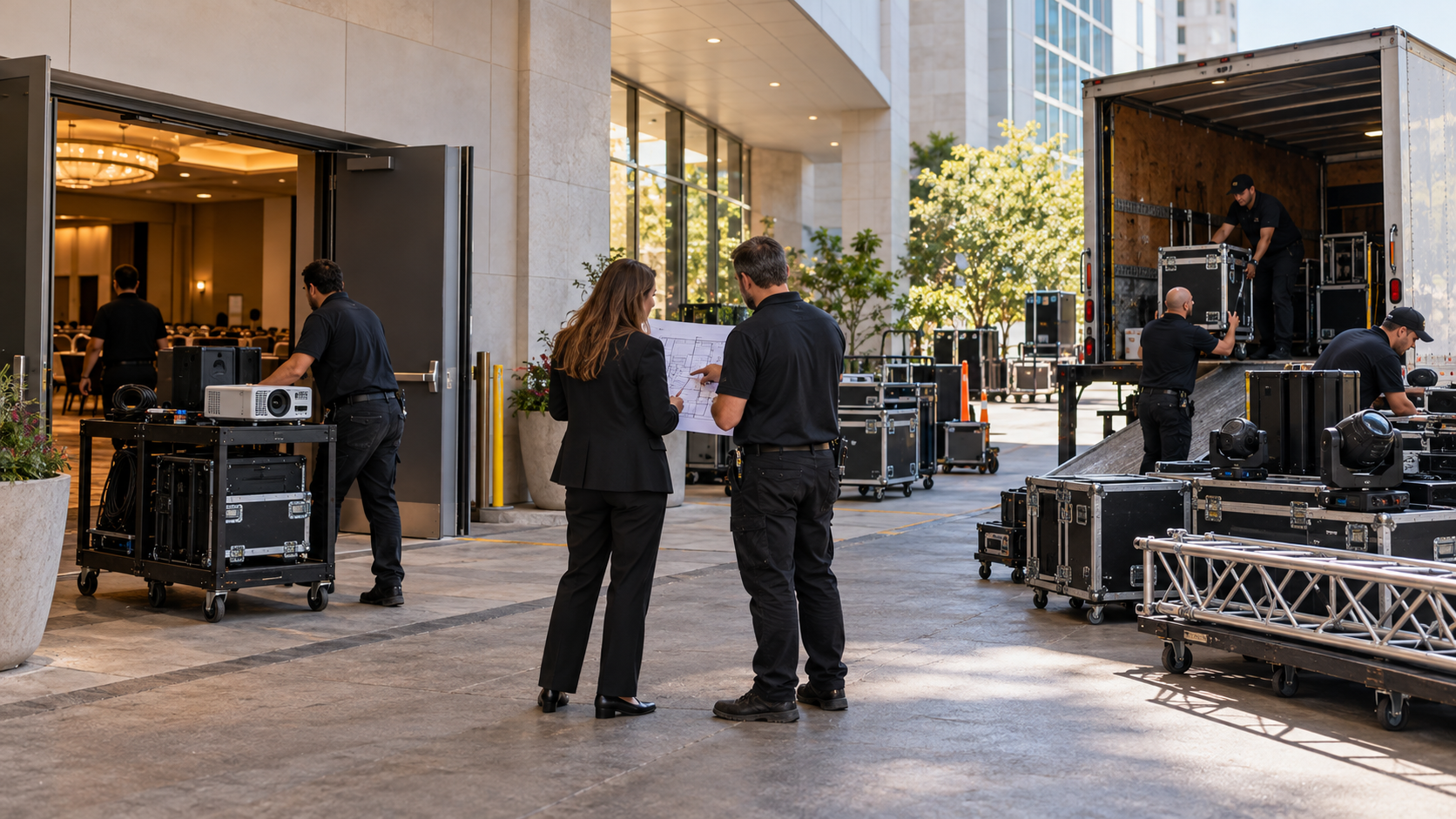
Choosing Between Venue AV and Independent Production in Texas
Hotels, conference centers, convention facilities, corporate spaces, universities, churches, and other Texas venues operate very differently.
Some properties have extensive in-house technical capabilities.
Others provide a more basic AV offering.
Some events fit comfortably inside those systems. Others require a more customized production model.
There is no reason to automatically reject the venue’s in-house AV solution, and there is no reason to automatically bring in an outside company.
Define the event first.
Understand what the venue can provide.
Identify what the production actually requires.
Then determine which model gives the event the appropriate level of technical support, customization, and production ownership.
For organizations planning technically demanding events in Texas, Verum AV Solutions provides event production and audiovisual support that can be coordinated with hotels, conference centers, and other event venues.
If you are unsure whether your venue’s AV offering is enough for your upcoming program, you can also review Verum’s AV and event production FAQs or discuss the technical scope with the team before deciding which production model makes the most sense.