How much AV does your event actually need?
It sounds like a simple question, but event planners are often forced to answer it before they have enough information.
One proposal might include a few microphones, screens, and technicians. Another may include cameras, custom lighting, LED displays, staging, presentation management, rehearsals, multiple crew positions, and full show-day production.
Is the larger proposal excessive?
Is the smaller one missing something important?
The answer depends less on how impressive the equipment list looks and more on what your event actually needs to accomplish.
For Texas conferences, corporate meetings, fundraisers, worship events, association programs, and other live events, right-sizing AV means matching the production plan to the audience, venue, content, schedule, complexity, and consequences of something going wrong.
Here are the questions that can help you determine the right level of production.
Does Audience Size Determine How Much AV You Need?
Audience size matters, but it is only one part of the equation.
A larger room may require more audio coverage, larger displays, additional lighting, or different staging. However, a smaller event can still be technically complicated.
Consider two events.
The first is a 1,500-person gathering with one stage, one speaker at a time, basic presentations, and a straightforward schedule.
The second is a 400-person executive conference with multiple cameras, remote presenters, custom video content, a detailed run of show, panel discussions, recording, livestreaming, breakout rooms, and frequent speaker transitions.
The second event may require significantly more production planning even though the audience is much smaller.
That is why headcount should help define the AV plan, not determine it by itself.
When Is Basic AV Enough?
Not every event needs full-scale production.
A relatively simple meeting may only require:
One or two presentation displays
A small number of microphones
Clear room audio
Presentation playback
Basic stage or room lighting
A technician for setup and support
If the agenda is simple, the venue is appropriate, the audience can clearly hear and see the content, and there are few technical dependencies, adding more production may not create meaningful value.
For example, a leadership meeting with 100 attendees and several PowerPoint presentations may not need cameras, LED walls, elaborate staging, or a large technical crew.
The goal should never be to add technology simply because it is available.
The goal is to give the event what it needs to work well.
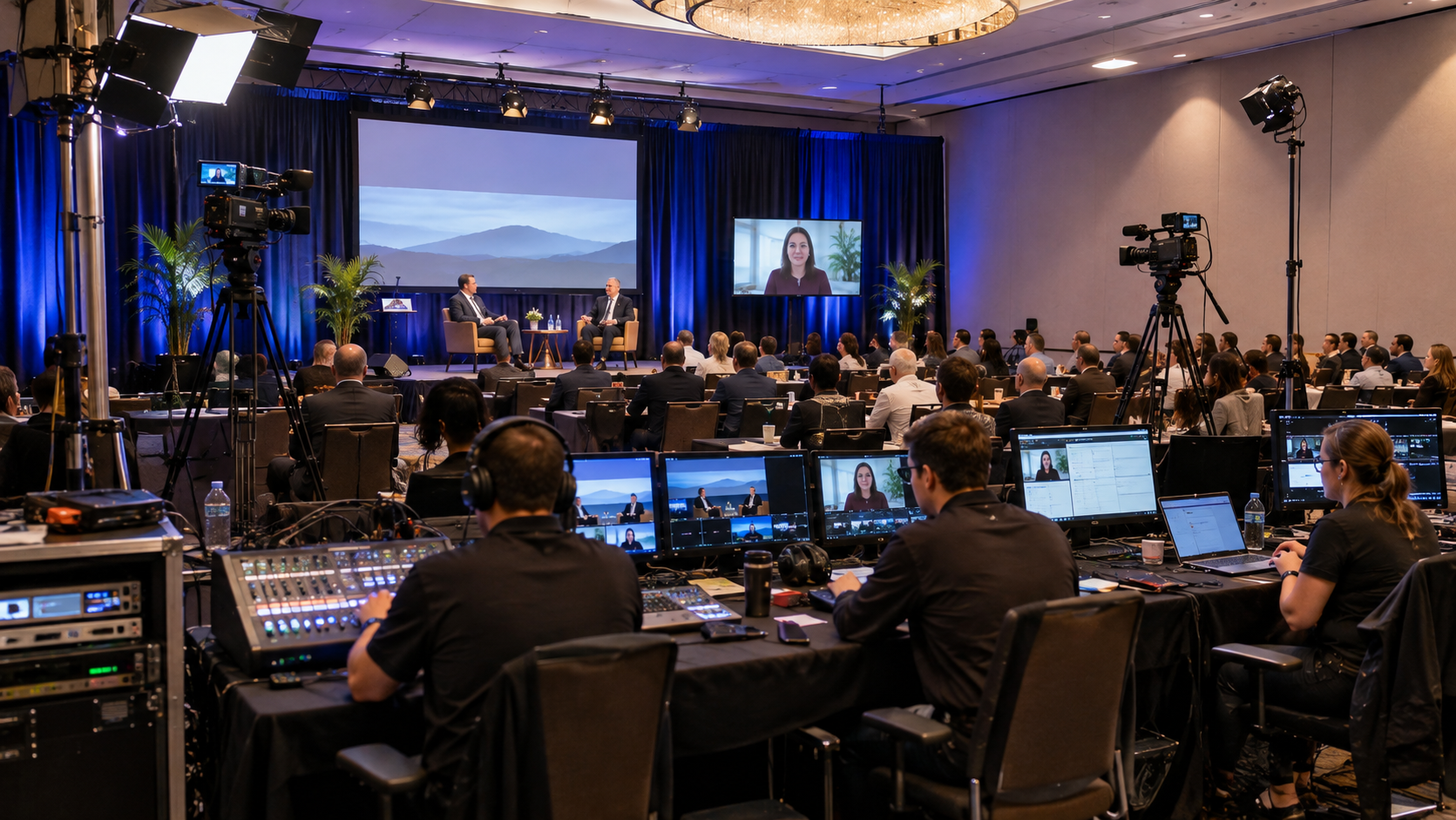
At What Point Does a Meeting Become a Production?
The transition usually happens when multiple technical elements begin depending on one another.
Imagine a conference with:
A custom stage
Several speakers
Panel discussions
Video playback
Multiple presentation decks
Cameras
Large displays
Lighting cues
Walk-in music
Remote participants
Livestreaming
Multiple rooms
A tightly timed agenda
Individually, none of those elements is unusual.
The complexity comes from making them work together.
A video cue affects audio and screens. A speaker transition may affect microphones, cameras, lighting, and presentation playback. A schedule change may require several technicians to adjust at the same time.
At that point, you are no longer simply putting equipment into a room.
You are managing a live production.
That is where a full-service event production company may become more appropriate.
How Do Multiple Rooms Change AV Requirements?
One ballroom is one technical environment.
A conference with a general session and six breakout rooms is seven technical environments that also need to function as one event.
Each room may need its own microphones, presentation systems, displays, audio, and technical support.
Then additional questions appear.
Are presenters moving between rooms?
Are the same presentations being used in several sessions?
Does content need to be updated throughout the day?
Are any rooms being recorded?
Does the general session feed need to appear in an overflow space?
Is there a central speaker-ready area?
Will breakout sessions eventually transition into another general session?
The more rooms involved, the more important coordination becomes.
Right-sizing AV for a multi-room event is not simply multiplying one room package by the number of rooms. Different spaces may need different levels of equipment and staffing.
How Much Does the Number of Speakers Matter?
Speaker count affects production more than many planners expect.
One keynote speaker using a single microphone and presentation deck creates a relatively simple technical workflow.
Twenty speakers can create a very different one.
Each person may arrive with different presentation files, videos, microphone preferences, stage movements, or last-minute changes.
Panel discussions add additional microphones and more complicated audio management.
Executives may need confidence monitors.
Remote speakers introduce connectivity, monitoring, audio routing, and communication requirements.
The more people participating in the program, the more valuable presentation management, rehearsals, soundchecks, and technical coordination can become.
Do You Need Cameras?
Cameras can dramatically change the scope of an event.
A camera may be needed simply so attendees at the back of a large ballroom can see the speaker clearly on the screen.
Other events may use multiple cameras for recording, livestreaming, interviews, or a more polished visual experience.
Once cameras are involved, additional decisions follow.
Where can they be positioned without blocking attendee sightlines?
What will appear behind the speaker?
How will stage lighting look on camera?
Who switches between camera angles?
Where will the video signal go?
Will content and cameras appear together on screen?
Will the event be recorded?
A single decision to add cameras can affect several other parts of the production plan.
Does Your Event Need LED Walls or Will Projection Work?
Not every event needs an LED wall.
Projection can still be appropriate in many rooms and event formats.
The correct display solution depends on factors such as room dimensions, audience size, viewing distance, available space, ambient light, content, stage design, and the visual experience you are trying to create.
A corporate meeting showing presentation slides has different requirements from a product launch built around high-impact visuals.
The important question is not which display technology is more impressive.
It is which one supports the content and audience effectively.
This is one reason AV planning should happen after the event goals and venue are understood rather than beginning with a list of equipment.
When Does Lighting Need to Go Beyond Basic Room Lighting?
For some meetings, lighting simply needs to make the speaker clearly visible.
For others, lighting becomes part of the production design.
A leadership conference may use lighting to separate the stage from the ballroom.
A gala may need different looks for dinner, presentations, entertainment, and fundraising moments.
A product launch may require lighting cues tied to video or a reveal.
An event being recorded or streamed may need lighting designed with cameras in mind.
The appropriate lighting plan depends on what is happening in the room.
Verum’s audiovisual services include lighting, audio, live video, stage design, projection, screens, livestreaming, event coordination, and on-site support, allowing those systems to be planned together when an event requires more than a basic setup.
Does Livestreaming Automatically Mean a Large Production?
Not necessarily.
A simple webcast and a highly produced hybrid conference are very different.
A basic stream might involve one camera, presentation content, and a straightforward online audience.
A more complex hybrid event may include:
Multiple cameras
Remote presenters
In-room audience microphones
Online Q&A
Presentation switching
Separate audio mixes
Remote audience monitoring
Recording
Multiple content sources
The important question is how integrated the online audience needs to be with the live event.
The more interaction and production quality expected, the more technical planning is usually required.
How Does a Multi-Day Event Change the Production Plan?
A two- or three-day conference is not simply a one-day event repeated several times.
Content changes.
Speakers change.
Rooms may be reconfigured.
Presentations need to be updated.
Equipment needs to remain secure and operational.
Crew schedules need to account for setup, rehearsals, show hours, resets, and strike.
Multi-day events can also create opportunities to standardize parts of the production.
Once the core technical systems are established, they can often support several days of programming while selected elements change around them.
The production scope should account for the complete event timeline, not just the hours when attendees are sitting in the room.
What Makes an AV Package “Overkill”?
An AV package is overbuilt when the added production elements do not meaningfully support the audience, content, reliability, or goals of the event.
More microphones than the program can use do not improve the event.
A large LED installation may not be necessary in a room where appropriately sized projection already works well.
Additional technicians do not automatically create better production if there are no roles for them to perform.
Likewise, an elaborate stage may not provide value for an internal meeting where the primary objective is discussion.
Right-sizing means being willing to remove unnecessary elements, not simply add them.
Verum’s public FAQ specifically notes that event production recommendations depend on event size, venue, equipment needs, crew, schedule, design complexity, streaming needs, and the level of production support required.
That is the right way to think about the scope.
What Happens When an Event Is Under-Produced?
Going too far in the other direction also creates problems.
A technically complex program can become difficult to execute if the AV scope does not account for all of its dependencies.
Examples include too few microphones for the program format, displays that are too small for the audience, insufficient crew for multiple rooms, inadequate rehearsal time, missing presentation support, or a production schedule that does not allow enough time for setup and testing.
The problem is not simply using less equipment.
It is creating a mismatch between the production plan and the event.
A lean AV plan can be excellent when it is deliberate.
A plan becomes risky when important requirements were removed simply to make the equipment list smaller.
How Much Crew Does Your Event Need?
Crew size should follow the work that needs to happen.
A simple meeting may need one technician.
A more complex event might require different people responsible for audio, video, lighting, cameras, presentations, stage activity, or overall show coordination.
Verum publicly lists technical crew roles that can include audio engineers, lighting operators, video technicians, camera operators, stagehands, show callers, and production support depending on event needs.
That does not mean every event needs every role.
It means staffing should reflect what the program actually requires.
If one technician is expected to run audio, manage presentations, operate cameras, troubleshoot video, coordinate speakers, and respond to last-minute requests at the same time, the event may be understaffed even if the equipment itself is adequate.
How Early Should You Decide the AV Scope?
The more complex the event, the earlier AV planning should begin.
Venue layout, audience size, content, staging, room schedules, streaming, speaker requirements, power, rigging, internet access, and rehearsal time can all influence the technical plan.
Making those decisions early also gives the production team more opportunities to simplify the scope.
Good planning does not always result in more production.
Sometimes it reveals that certain equipment or staffing is unnecessary.
That is another benefit of involving the technical team before every detail has already been locked in.
A Simple Right-Sizing Framework for Texas Event Planners
Before deciding how much production to purchase, answer these questions:
How many people need to see and hear the program?
How many rooms are involved?
How many presenters and performers are participating?
Are cameras required?
Is the event being recorded or livestreamed?
How complicated is the presentation content?
Are there custom lighting or staging requirements?
How frequently will the program change throughout the day?
Are rehearsals or technical run-throughs required?
How significant would a technical interruption be?
If most answers are simple, the production plan may also be simple.
If several answers introduce additional systems, rooms, people, or dependencies, the event may require a more comprehensive production approach.
The Right AV Plan Is Not the Biggest One
A professional AV plan should not be measured by how much equipment arrives at the loading dock.
It should be measured by whether the audience can hear, see, understand, and experience the event the way the organizer intended.
For some events, that means microphones, screens, and a capable technician.
For others, it means a coordinated production involving audio, video, cameras, lighting, staging, streaming, rehearsals, presentation support, and a larger technical team.
Neither approach is inherently better.
The better approach is the one that matches the event.
For organizations planning conferences, meetings, galas, nonprofit programs, worship events, and other live events across Texas, Verum AV Solutions provides corporate event production and AV support that can be scoped around the requirements of the program.
If you are still determining what your event actually needs, Verum’s AV and event production FAQs are another useful starting point before defining the final production scope.