Before and After: What Changes When You Standardize AV for Recurring Corporate Events
Organizations that produce the same conference, fundraiser, leadership meeting, awards program, or corporate gathering every year often approach each edition as a new event.
The venue may change. Attendance may grow. The agenda may evolve. Speakers and creative elements may be different.
But that does not mean the audiovisual production process has to start from zero every time.
For recurring corporate events, a repeatable production approach can carry useful technical knowledge from one event to the next while still leaving room for the program to evolve.
The difference is simple: instead of treating each event as an isolated project, the organization begins treating its AV production as an ongoing program.
Before: Every Event Starts From Scratch
Imagine an organization that hosts a major conference every year.
Each year, the planning team gathers the agenda, explains presentation requirements, reviews the stage layout, discusses microphones, determines screen sizes, plans lighting, builds a run of show, and works through venue logistics.
Much of that work is necessary. Every event has unique requirements.
The problem comes when useful production knowledge from the previous event is not carried forward.
The team may end up answering the same questions again:
How many microphones did we actually need?
Which presentation workflow worked best?
Where did speakers enter and exit?
Which stage layout supported the program?
How were videos and walk-in music handled?
What technical issues appeared during rehearsal?
Which elements should be changed next year?
When those decisions live only in email threads, individual memories, or last year's production documents, each new planning cycle can involve unnecessary reconstruction.
After: The Event Has a Repeatable Production Baseline
A recurring event production program starts differently.
Instead of beginning with a blank page, planners begin with a documented production baseline from the previous event.
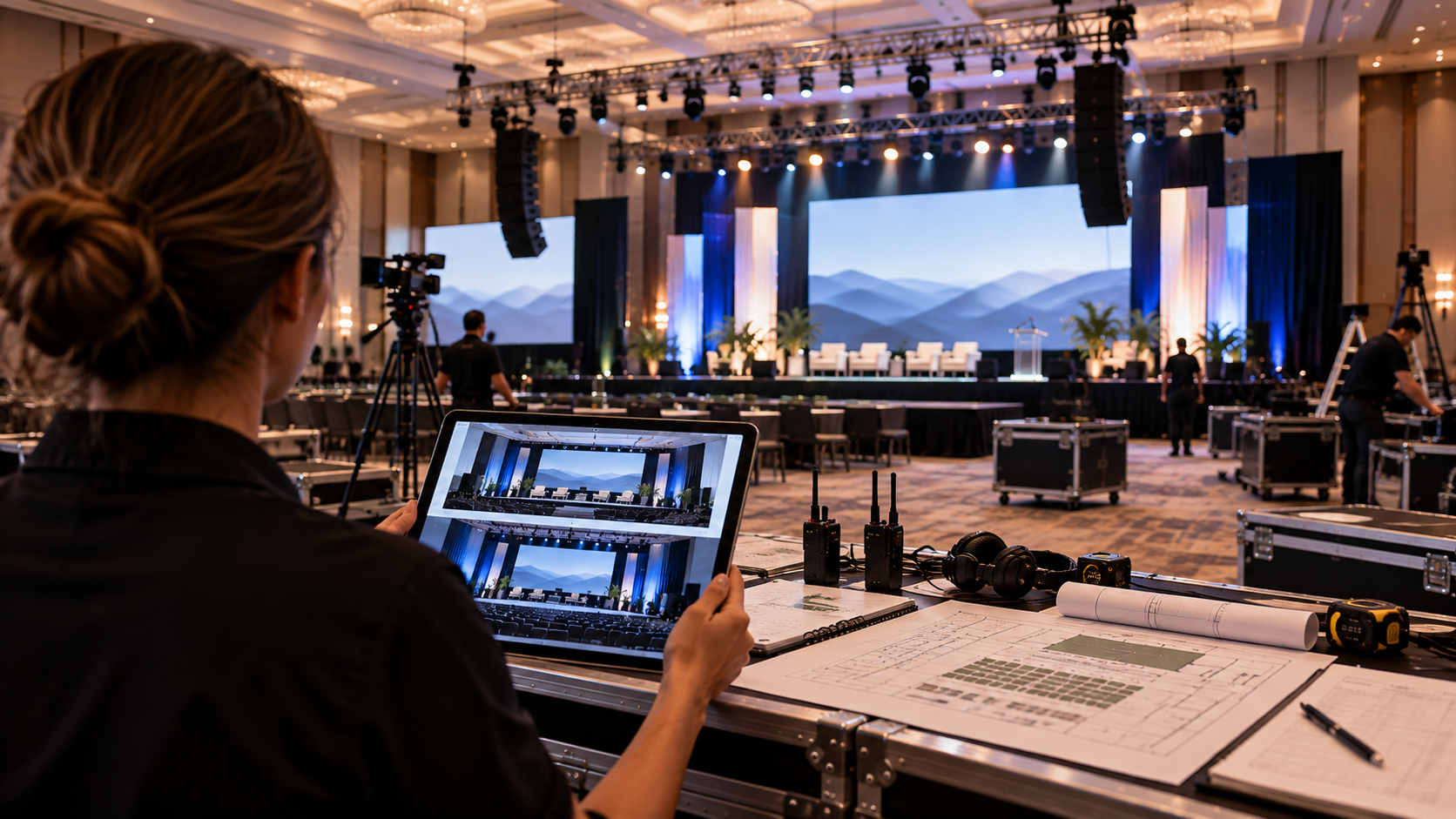
That baseline might include the technical scope, stage layout, equipment requirements, presentation workflow, staffing structure, show flow, visual standards, recordings, venue notes, and lessons from the previous production.
The next event does not have to duplicate the previous one. The documentation simply provides a more informed starting point.
A full-service event production approach can be especially useful when audio, video, lighting, staging, cameras, presentation systems, and technical personnel all need to evolve together from one event cycle to the next.
What Can Be Standardized Across Recurring Events?
Standardization does not mean making every event look identical.
It means identifying the production decisions that do not need to be reinvented unless the event changes.
Technical Specifications
Recurring programs can maintain a baseline for audio, video, display, lighting, camera, playback, and presentation requirements.
If attendance or venue conditions change, those specifications can be adjusted rather than rebuilt without context.
Presentation Workflows
How speakers submit presentations, where files are reviewed, how last-minute updates are handled, and how content reaches the screens can become part of a repeatable process.
Stage and Room Layouts
Stage dimensions, display locations, camera positions, technical control locations, speaker entrances, and audience sightlines can all be documented.
When the next event moves to a different venue, the production team can adapt a known design rather than trying to rediscover the program's needs.
Show Flow and Technical Cues
Recurring events often contain familiar program elements such as opening videos, keynote presentations, panel discussions, awards, walk-up music, sponsor content, entertainment, and closing remarks.
Documenting how those elements were executed creates a foundation for the next run of show.
Post-Event Findings
Some of the most useful information becomes available after the event is over.
Which parts of the technical plan worked well? Where did the schedule create pressure? Did the room layout support the audience? Were there unnecessary pieces of equipment? Did speakers need more rehearsal time?
Recording those findings gives the next event planning cycle something concrete to build from.
What Should Not Be Standardized?
A repeatable event production program should not become rigid.
Several variables need to be reviewed for every event:
Venue dimensions and restrictions
Audience size
Agenda changes
Speaker requirements
Entertainment
Branding and creative direction
Livestreaming or recording requirements
Available load-in and rehearsal time
Local labor and venue requirements
New technical objectives
The goal is not to copy last year's event. It is to preserve what is useful so the planning team can spend more time improving the parts that actually need to change.
A Simple Before-and-After Example
Consider a hypothetical company that holds the same annual conference each year.
Year One
The production team develops the technical scope from the beginning.
They determine the audio requirements, display configuration, stage layout, lighting approach, camera positions, presentation workflow, staffing needs, rehearsal schedule, and show cues.
During the event, the team learns how the program works in practice.
After Year One
The useful information is documented rather than discarded.
The final technical specifications are saved.
The stage and room layouts are preserved.
The completed show flow is retained.
Presentation workflows are documented.
Production notes identify what should change.
Useful recordings and visual references are archived.
Year Two
Planning begins with those records.
If attendance increases, the audio and video systems can be reconsidered. If the venue changes, the stage concept can be adapted. If the agenda includes a new type of session, the production workflow can expand to support it.
The team is still designing an event. It simply has more information available when making those decisions.
Why Production Continuity Matters for Annual Events
Recurring programs create an opportunity that one-off events do not have: the ability to learn from previous editions.
That continuity can support several parts of the production process.
More Consistent Technical Standards
An organization can define what acceptable audio, visual presentation, stage design, camera coverage, and technical support should look like across its events.
Less Repeated Discovery
Planners do not need to repeatedly explain every technical preference or rediscover every workflow when the information has already been documented.
A Better Starting Point for Improvement
When the previous production is documented, the next discussion can begin with what should be improved instead of spending the entire planning process reconstructing what happened last time.
Stronger Continuity Across Teams
Event teams change. Employees move into new roles. Agencies and stakeholders may rotate.
A documented production program reduces reliance on one person's memory and gives future planners a clearer record of how the event has been produced.
Recurring Events Across Multiple Cities Add Another Layer
The same principle becomes even more important for roadshows, regional meetings, multi-city conferences, training programs, and event series.
A Houston event and a Dallas event may take place in very different venues, but they can still share a common production framework.
For example, the program may establish consistent expectations for:
Stage appearance
Presentation displays
Audio quality
Microphone requirements
Brand visuals
Camera coverage
Playback workflows
Technical staffing
Speaker support
Show documentation
Those standards can then be adapted to the realities of each venue.
This is different from trying to force the exact same equipment package into every location. A repeatable production system defines the desired result and the important technical standards while allowing the implementation to change when necessary.
Which Events Benefit Most From a Repeatable AV Production Plan?
This approach is particularly relevant for organizations that produce similar programs throughout the year or return to the same major event annually.
Examples include:
Annual corporate conferences
Association meetings
Quarterly leadership meetings
Sales kickoffs
Awards programs
Recurring nonprofit fundraisers
Annual worship conferences
Company town halls
Training programs
Regional roadshows
Multi-city corporate event series
Organizations with several different event formats can also benefit by establishing common audiovisual standards that apply across the broader event calendar.
How to Build a Repeatable Production Framework
1. Document the Production That Actually Happened
Do not rely exclusively on the original plan.
Preserve the final technical configuration, stage layout, show flow, staffing structure, and workflows that were actually used.
2. Separate Standards From Event-Specific Decisions
Identify which production elements should remain consistent and which were unique to that venue, audience, or agenda.
For example, microphone preferences or presentation workflows may carry over easily, while speaker placement or screen size may need to change based on the next venue.
3. Record What Should Change Next Time
A production debrief is most useful when it creates actionable information for the next event rather than simply reviewing what went right or wrong.
Useful questions can include:
Which technical elements created unnecessary complexity?
Were the rehearsal windows long enough?
Did the stage layout work for the speakers and audience?
Did presentations move through the system efficiently?
Were there parts of the program that required more crew support?
What would make the next event easier to execute?
These observations can become part of the planning process for the next event cycle.
4. Start the Next Event With the Existing Baseline
Use the previous production as a reference, then evaluate what has changed in the venue, attendance, agenda, creative direction, technology, and event objectives.
Instead of asking, “What did we do last year?” halfway through planning, the previous production becomes the starting point.
5. Keep Improving the System
A recurring event program should become more informed with each cycle.
That does not mean adding more equipment every year.
Sometimes improvement means simplifying a workflow, changing a room layout, removing unnecessary complexity, or making the technical plan easier for presenters and event staff to use.
Why This Matters for Multi-City Corporate Programs
Multi-city events introduce another challenge: consistency without assuming that every venue is identical.
A corporate roadshow may visit Houston, Dallas, Austin, San Antonio, and other markets while maintaining the same brand, presentations, speakers, and general program structure.
But each venue can have different:
Room dimensions
Ceiling heights
Rigging capabilities
Load-in procedures
Power access
Internet infrastructure
Stage configurations
Audience layouts
A repeatable AV production framework helps separate the parts of the program that should remain consistent from the parts that need to adapt locally.
The result is not necessarily identical equipment in every city.
The goal is a consistent audience and presenter experience supported by a technical plan appropriate for each location.
Standardization Can Also Help Presenters
Recurring event production is not only about equipment and crew.
Presenters often benefit from consistent workflows as well.
If speakers know how presentations are submitted, where rehearsals happen, what microphones will be used, where confidence monitors are positioned, and how stage transitions work, there are fewer new processes to learn at each event.
That consistency can be especially useful for leadership teams or presenters who participate in multiple events throughout the year.
It also gives the production team a clearer process for handling last-minute presentation updates and other common show-day changes.
The Goal Is Consistency Without Becoming Rigid
There is an important balance in recurring event production.
Standardize too little, and the team may repeatedly solve the same problems.
Standardize too much, and the production plan may stop adapting to the needs of the current event.
The strongest approach is usually to standardize the process and expectations while continuing to design the technical implementation around each event.
That means preserving useful production knowledge without assuming that last year's solution is automatically the right solution this year.
Recurring Events Should Build on What You Already Learned
An annual conference may happen once a year, but it does not have to be treated like a first-time event every year.
When technical specifications, show flows, layouts, production notes, and lessons learned are carried forward, planners have a stronger starting point for the next event.
The objective is not repetition for its own sake. It is continuity with room to improve.
For organizations producing recurring corporate events, conferences, fundraisers, or multi-city programs in Texas, Verum AV Solutions provides audiovisual services and event production support.
If you are planning a recurring event series and want to discuss the technical scope for upcoming programs, you can contact Verum AV Solutions to start the conversation.