Event Design Services for Corporate Events: From Generic Ballroom to Branded Experience
A corporate event can have flawless audio, sharp screens, and reliable technology and still feel generic.
That happens when audiovisual production is treated only as a list of equipment instead of part of the event design.
For conferences, product launches, leadership meetings, galas, awards programs, and other corporate gatherings, the stage, lighting, displays, room layout, and visual environment all influence how the audience experiences the message.
Effective event design services bring those elements together intentionally. The goal is not to add more technology for the sake of spectacle. It is to design an environment that fits the venue, supports the program, reflects the organization, and helps the audience know where to look and what matters.
The Difference Between Functional AV and Designed AV
Functional AV answers basic technical questions.
Can everyone hear the presenter?
Can the audience see the presentation?
Are there enough microphones?
Will the video play correctly?
Is there enough light on the stage?
Those questions are essential, but they are only the beginning.
Custom event design asks another layer of questions.
What should the room feel like when guests enter? What should draw their attention first? How should the stage frame the keynote speaker? How should a company's visual identity appear on screens without overwhelming the presentation? How should lighting change as the program moves from a keynote to an award presentation or evening reception?
That is where audiovisual production begins to function as part of the experience instead of remaining in the background as equipment.
1. Start With the Venue, Not the Equipment List
Creative AV design should begin with the actual space.
Two events with similar agendas can require very different production designs if one is held in a wide hotel ballroom and the other in a narrow conference hall.
Ceiling height, room width, audience depth, stage location, entry points, existing architecture, rigging options, camera positions, and sightlines can all influence the design.
This is why Verum AV approaches production around the venue, audience, stage, and event schedule rather than relying on one equipment package for every room.
Its event production services bring technical planning together with audio, video, lighting, staging, and live execution.
The room should shape the production plan, not the other way around.
2. Design the Stage Around the Message
The stage is usually the visual center of a corporate event.
That does not mean it needs to be large or elaborate. It means its design should make sense for what will happen on it.
A keynote presentation may need a clean focal point and strong presentation displays. A panel discussion may require comfortable sightlines between speakers and the audience. An awards program may need space for walk-ons, recognition moments, video playback, and photography. A product launch may place much more emphasis on visual reveals and branded content.
Good stage design considers those movements before deciding where screens, lecterns, furniture, lighting positions, cameras, and other elements belong.
Verum's audiovisual services include stage design alongside lighting, live video, projection, screens, and audio, allowing those elements to be considered as parts of the same environment.
3. Use Lighting as Part of the Visual Architecture
Lighting does much more than make the stage bright enough to see.
It can define areas of the room, separate the stage from the background, reinforce brand colors, create visual depth, guide attention, and change the atmosphere as the program progresses.
Consider a corporate conference that begins with an executive keynote, transitions into a panel discussion, and ends with an awards reception.
The same room may need to feel focused and professional during the keynote, conversational during the panel, and more energetic during the evening program.
Lighting can help create those transitions without physically rebuilding the room.
The important distinction is intentionality. Colors, intensity, movement, and focus should support what is happening rather than compete with it.
4. Make LED Displays and Screens Part of the Design
Screens are often treated as places to put PowerPoint slides.
They can play a much larger role in the visual design of an event.
LED displays, projection surfaces, presentation screens, and confidence monitors all have different functions. Their size, position, proportion, and content should work with the stage rather than feel like equipment added after the design is finished.
For example, a wide LED backdrop may create a very different visual experience from two traditional projection screens placed on either side of a stage.
Neither approach is automatically better.
The appropriate solution depends on the room, viewing distance, content, camera needs, budget, and creative goals.
The design question should be: what role does this display need to play in the experience?
5. Bring the Brand Into the Environment Without Overdoing It
A branded corporate event does not require placing a logo on every available surface.
Brand alignment can be much more subtle.
Lighting can use colors that complement the organization's visual identity.
Stage proportions can reflect the tone of the event.
Display content can use consistent graphic treatments.
Walk-in visuals can establish the atmosphere before the program begins.
Transitions between sessions can maintain a consistent visual language.
Stage backgrounds can give speakers a polished environment for both the audience and cameras.
Verum's corporate event production services include AV setups designed to align with a company's brand identity.
The objective is not simply to decorate the room. It is to create visual consistency between the company's message and the environment where that message is being delivered.
Learn more about corporate event production and how audiovisual elements can support the overall presentation of a business event.
6. Design for the People in the Room
An impressive stage is not successful if a large portion of the audience cannot see it clearly.
Creative design still needs to solve practical problems.
Audience size and room layout can affect screen size, speaker placement, stage height, camera positions, lighting angles, and how presentation content should be displayed.
A design that looks impressive from the front row may perform very differently from the back of a ballroom.
That is why sightlines and audience perspective should be considered early rather than checked after the equipment is already positioned.
7. Remember That Cameras See the Event Differently
Corporate events are increasingly viewed through more than one perspective.
Even when an event is primarily in person, cameras may be used for recording, live image magnification, promotional content, internal communications, or remote viewers.
That makes camera framing part of the design conversation.
Lighting that looks acceptable to the eye may appear differently on camera. A stage background that works from the center of the ballroom may look empty or distracting in a close-up shot. Large displays can also affect exposure and framing.
Considering cameras during the design phase helps the event look intentional both in the room and on screen.
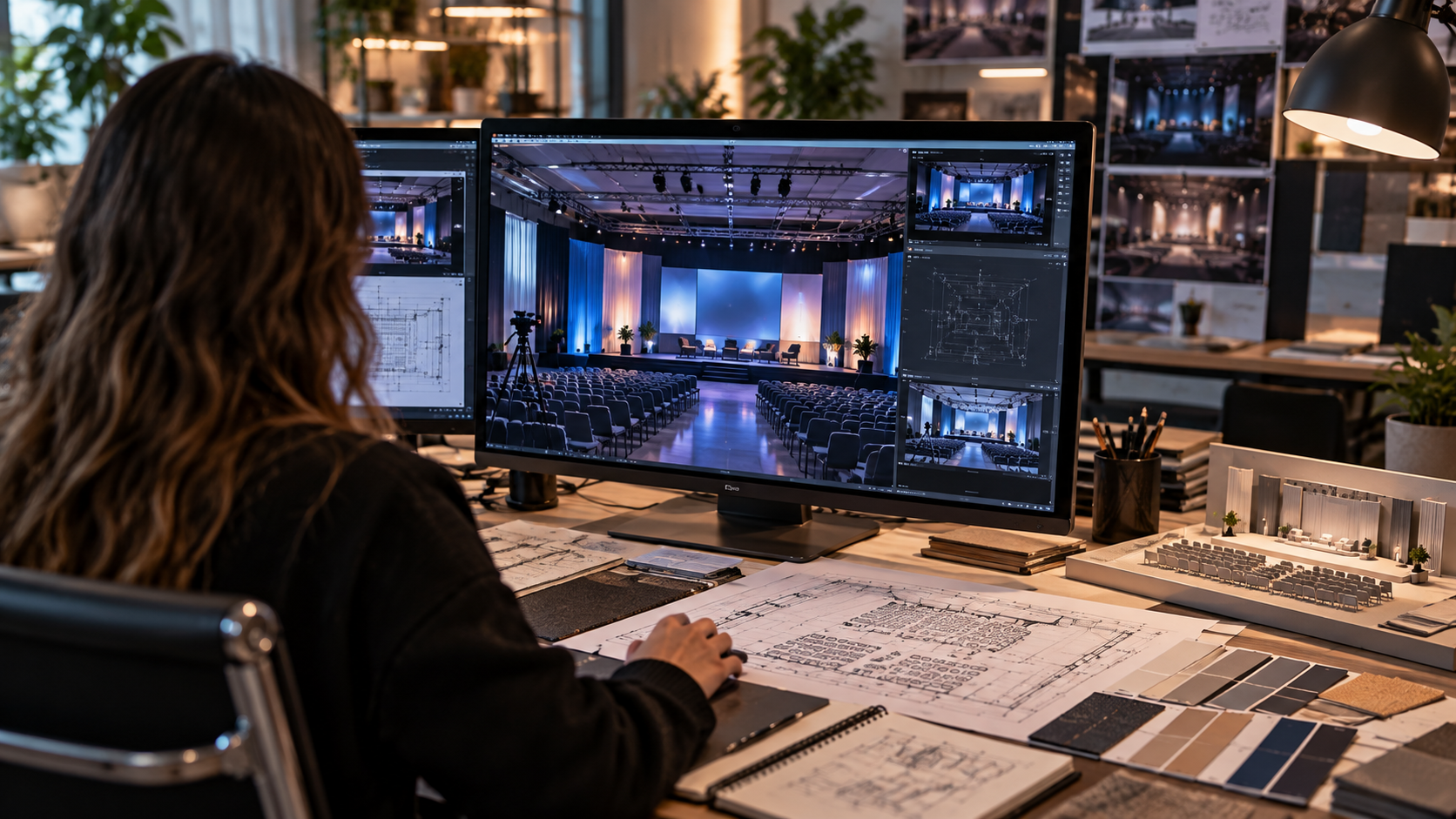
8. Visualize the Event Before Load-In
One of the challenges of event production is that planners often have to approve a concept before they can physically see it.
A floor plan can show where equipment goes, but it may not communicate what the finished environment will feel like.
For events that benefit from additional visualization, Verum AV offers custom 3D event renderings that can show proposed staging, lighting, screens, LED displays, cameras, audio placement, and room layout before event day.
This gives planners another way to evaluate the production concept while there is still time to make adjustments.
Instead of discovering on load-in day that a screen feels undersized, the stage looks unbalanced, or an important visual element competes with the room architecture, those conversations can happen earlier in the process.
9. Know When Immersive Design Adds Value
Immersive does not have to mean complicated.
A successful immersive event does not necessarily need every new technology available.
The goal is to make the audience feel that the environment, visuals, sound, and program belong together.
For one event, that might mean dynamic lighting and a large visual backdrop.
For another, it might mean a clean stage with carefully placed displays and restrained brand colors.
A product launch may benefit from dramatic visual transitions, while an executive summit may call for a much more controlled design.
Adding technology without a purpose can make an event busier without making it better.
The strongest creative decisions begin with the audience experience and event objective, then use technology to support them.
What Custom AV Design Can Look Like for Different Corporate Events
Conferences and Summits
Conference design often needs to balance keynote impact with practical presentation requirements.
Screens need to remain readable, speakers need to move naturally, cameras need usable angles, and visual elements should remain consistent across multiple sessions.
Product Launches
A product launch may use lighting, video content, staging, and timed visual changes to build attention around a reveal or key message.
Galas and Awards Programs
These events may need to transition between speeches, videos, awards, entertainment, and social portions of the evening.
Lighting and visual content can help distinguish those moments while maintaining a consistent overall environment.
Leadership Meetings and Executive Events
These events often benefit from a more restrained design.
Clean staging, strong presentation displays, thoughtful camera positions, and polished lighting can create a professional environment without making the production feel excessive.
Questions to Answer Before the Design Process Begins
Before deciding what the event should look like, define what it needs to accomplish.
What should guests feel when they enter the room?
What is the most important message of the event?
Which moments need the strongest visual emphasis?
Will the event be photographed, recorded, or livestreamed?
How should the company's brand appear in the environment?
What presentation content will be shown?
How many different program formats will happen on the stage?
What should remain consistent throughout the event?
What venue characteristics should the design work with rather than fight against?
Those answers provide a much stronger creative brief than beginning with a request for a certain number of screens or lighting fixtures.
A Corporate Event Should Look Designed, Not Simply Equipped
Professional event production still depends on reliable equipment and technical execution, but those are not the only things an audience experiences.
Guests experience the room.
They see the stage.
They notice where their attention is directed.
They respond to lighting, visuals, sound, movement, and atmosphere even when they are not consciously thinking about the technology behind them.
Custom AV design brings those elements together so the production supports the event instead of simply occupying the room.
For organizations planning corporate events in Houston or elsewhere in Texas, Verum AV Solutions provides venue-specific production planning, stage design, lighting, video, displays, audio, and visual planning support.
Explore Verum's Houston corporate event production services to learn more about designing a production around your space, audience, and event goals.